- AI Horizons
- Posts
- ChatGPT Comes to Excel and Google Sheets, Google Health Adds AI Coaching, and arXiv Cracks Down on AI Papers
ChatGPT Comes to Excel and Google Sheets, Google Health Adds AI Coaching, and arXiv Cracks Down on AI Papers
PLUS: Local AI on Mac, a 12M-token LLM Breakthrough, and an NSA Warning for Home Routers
In partnership with

Welcome back to AI Horizons, your weekly guide to the latest in AI and tech for builders, leaders, and curious minds everywhere. Here’s what’s on deck:
ChatGPT spreadsheet add-ons
Google Health AI coach
arXiv bans AI slop
Local AI on Mac
SubQ’s huge context window
NSA router warning
FEATURED INSIGHT💡
ChatGPT Is Coming for Your Spreadsheet Busywork

Spreadsheets are where business decisions actually happen: forecasts, KPI reports, budgets, reconciliations, sales trackers, survey analysis, and financial models. Now ChatGPT is moving directly into that workflow with new add-ons for Excel and Google Sheets, letting users analyze, update, explain, and build spreadsheets without constantly switching tools.
Instead of manually creating formulas, debugging broken sheets, or summarizing trends across tabs, users can describe what they need in plain language and have ChatGPT help create the structure, formulas, summaries, and updates. It can also explain what it’s doing, reference the cells it used, preserve formatting, and ask before making changes.
Why it matters: AI is becoming less of a separate app and more of an embedded layer inside the tools teams already use every day. For businesses, this could save hours on repetitive spreadsheet work while letting people spend more time on analysis, decisions, and strategy.
Investors see ANOTHER return from Masterworks (!!!!)

That’s 6 sales in 7 months. 29 all time. And the performance?
16.5%, 17.6%, and 17.8%, net annualized returns on sold works held longer than one year (See all 29 at Masterworks.com)
It’s not from stocks, private equity, or real estate… it’s from contemporary and post war art. Crazy, right?
With Masterworks, you don’t need to be a BILLIONAIRE to invest in multi-million dollar art anymore.
Historically, the segment overall has had attractive appreciation and low correlation to stocks.*
Masterworks targets works featuring legends like Banksy, Basquiat, and Picasso, identifying what they believe to have significant long-term appreciation potential, not just at the artist level but at the level of individual artworks.
As one of the largest players in the art market, with $1.3 billion invested over 500 artworks, they pass critical advantages through to their 70,000+ members to add art to their portfolios strategically.
Looking to diversify your investments in 2026?
*According to Masterworks data. Investing involves risk. Past performance is not indicative of future returns. See important Reg A disclosures at masterworks.com/cd.
ON THE HORIZON 🌅
Google Health Wants to Turn Your Health Data Into Something You Can Actually Use

Google is rolling out a major update to the Fitbit app, transforming it into the new Google Health app, a central hub for fitness, sleep, wellness, vitals, medical records, and AI-powered coaching. The goal is to bring scattered health data into one place, including wearable data, medical records, workouts, meals, sleep, and trends.
The most interesting piece is the Google Health Coach, built with Gemini. It can help users ask questions based on their own health context, get summaries of medical records, prepare better questions for doctor visits, and receive wellness, workout, and sleep suggestions that account for their broader medical situation.
Why it matters: AI health assistants are moving from generic symptom checkers toward personalized health navigation. If this works, your wearable may become less of a step counter and more of a daily interface for understanding your body, your records, and your next best question.
LATEST IMPORTANT NEWS 📰
NSA says: reboot your router. The NSA is reminding U.S. internet users to reboot home routers regularly, update firmware, change default passwords, disable remote management, and replace end-of-support devices. The warning comes amid continued attacks targeting vulnerable routers, including campaigns tied to Russia’s GRU. The simple takeaway: your router is easy to forget, but it is one of the most important security devices in your home.
arXiv is cracking down on careless AI-generated research. arXiv will reportedly issue a one-year ban if a submission contains clear evidence that authors failed to review LLM-generated content, such as hallucinated references or leftover AI comments. The policy does not ban AI use, but it makes authors fully responsible for everything in the paper. For researchers, the message is clear: AI can help draft, but it cannot be treated as an unpaid coauthor with no fact-checking.
Osaurus brings local and cloud AI models to the Mac. Osaurus is an open-source Apple-only LLM server that lets users switch between local models and cloud providers while keeping files, memory, and tools on their own hardware. It supports local and cloud models, runs in a hardware-isolated virtual sandbox, includes native plugins for apps like Mail, Calendar, Filesystem, Browser, Git, XLSX, and PPTX, and positions itself as a more consumer-friendly way to use local AI without living in the terminal.
Attio - the AI CRM for modern businesses.
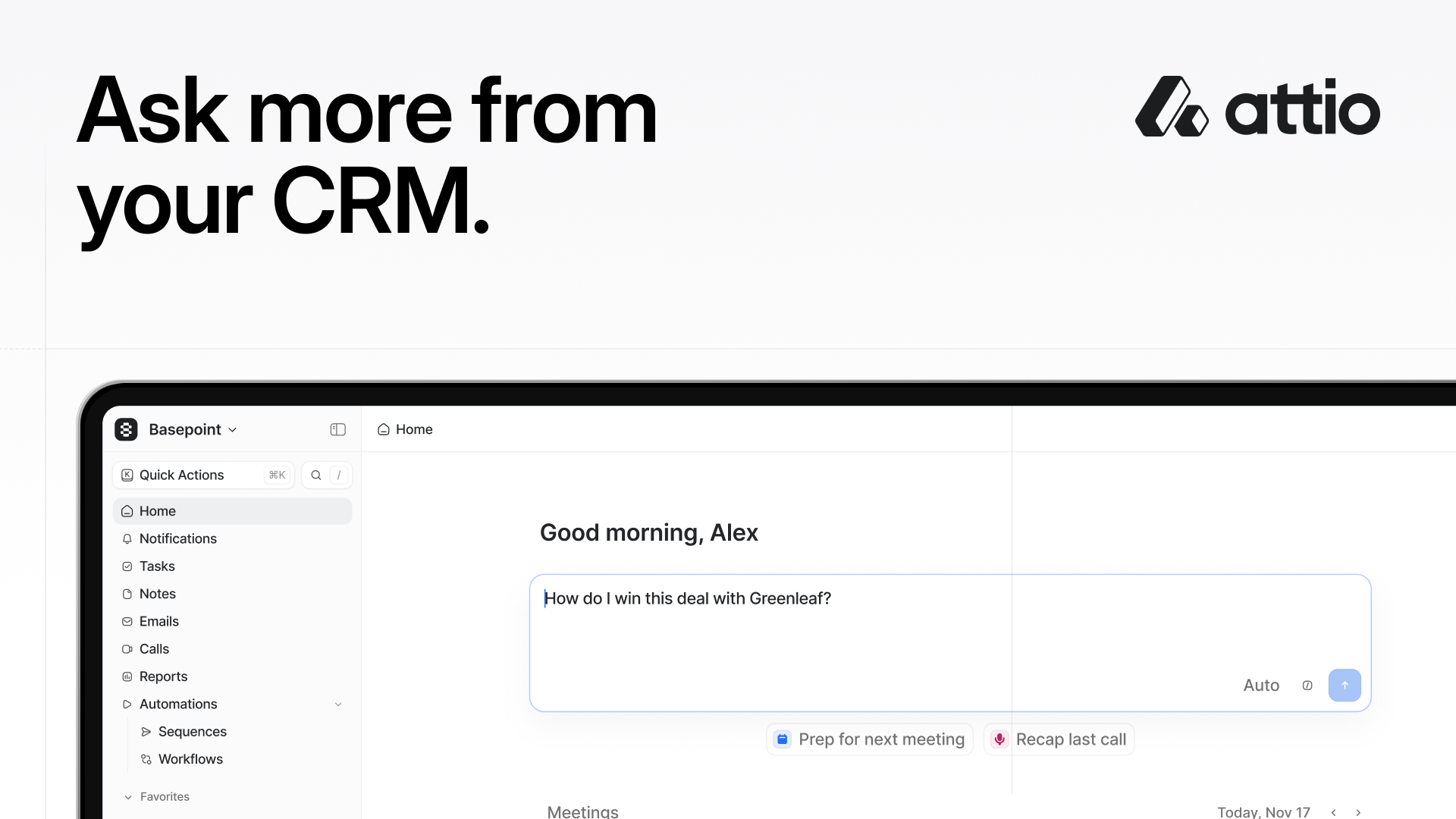
Attio is the AI CRM that keeps you ten steps ahead.
Ask Attio anything. Where should I focus? What deals are at risk? Search, update, and create across your customer data.
Ask more from CRM. Ask Attio.
FOR THE TECHNICALLY INCLINED 🛠️
SubQ and the Race Beyond Quadratic Attention
SubQ is being positioned as a major step forward in LLM architecture: a frontier model built on a fully sub-quadratic sparse-attention architecture with a reported 12 million token context window. The claim is that it can be dramatically faster and cheaper at massive context lengths by avoiding the standard transformer habit of comparing every token relationship with every other token relationship.
The deeper idea is important: if only a small fraction of token-to-token relationships actually matter, then future LLMs may scale by learning what to ignore. Sparse attention architectures could make ultra-long context windows more practical for codebases, legal archives, research libraries, patient histories, enterprise knowledge bases, and agent memory systems. If the claims hold up, this points toward a future where context length becomes less of a premium feature and more of a default capability.
AI TOOL OF THE DAY 🚀
AIApply helps job seekers find high-match roles, tailor resumes and cover letters, auto-apply, and get live coaching so they can move from applications to interviews faster.
It's Monday. Every department already has context. Nobody prepped anything.

Your CFO opens Slack. There's a weekly Stripe revenue recap in #finance with a churned-accounts flag and a net-new breakdown. She didn't ask for it.
Your head of product opens Slack. There's a GitHub summary in private channel: PRs merged, PRs stale, Linear tickets that moved. He didn't ask for it.
Your marketing lead opens Slack. There's a Google Ads performance comparison in private channel, with a note: "Meta CPA crept up 18% this week. Might be worth pausing the broad match campaign." She didn't ask for it either.
All-hands at 10am. Everyone already knows the numbers. The meeting is about decisions, not catch-up.
That's what happens when one colleague works across every tool your company uses. Not one department's assistant. The whole company's coworker.
Viktor lives in Slack. Top 5 on Product Hunt, 130 comments. SOC 2 certified. Your data never trains models.
"Not only have we caught up on several months of work, we are automating manual tasks and expanding our operations to things previously not possible at scale." - Jesse Guarino, Director, Torque King 4x4
That's all for now!
We'll catch you in the next one.
Cheers,
The AI Horizons Team
P.S. If you missed our last issue, no worries, you can check out all previous issues here!
P.P.S We value your thoughts, feedback, and questions - feel free to respond directly to this email!
... and if you enjoyed this email and would like to support our work and help us keep bringing you cutting-edge AI insights, you can donate here. Every bit makes a difference—thank you for your support!
What did you think about today's email? |