- AI Horizons
- Posts
- OpenAI Launches $150M Partner Network for 300,000 AI Consultants
OpenAI Launches $150M Partner Network for 300,000 AI Consultants
PLUS: Anthropic’s $85K Claude Corps fellowships, a moonshot to cut AI energy use by 1,000x, and video game data training real-world robots
In partnership with

Welcome back to AI Horizons, your weekly guide to the latest in AI and tech for builders, leaders, and curious minds everywhere. Here’s what’s on deck:
OpenAI’s Partner Network
Claude Corps Fellowships
1,000x Lower-Power AI
Games Training Real-World Agents
Agent Stress-Test Worlds
Qwen’s World Simulator
FEATURED INSIGHT💡
OpenAI Is Building the Distribution Layer for Enterprise AI

OpenAI has launched the OpenAI Partner Network, a global program for consulting firms, systems integrators, technology providers, and other partners that build, sell, and deploy solutions using its products. OpenAI is investing $150 million in the ecosystem and plans to train and enable 300,000 certified consultants by the end of 2026.
Partners will advance through Select, Advanced, and Elite tiers based on their technical capabilities, sales performance, deployment experience, and collaboration with OpenAI. They will eventually be able to earn specializations in areas such as Codex, cybersecurity, and AI agents. OpenAI is also piloting a Forward Deployed Experts program that gives selected partner practitioners deeper exposure to its deployment teams, technologies, and implementation playbooks.
Why it matters: Enterprise AI adoption increasingly depends on execution rather than access to capable models. Companies need help identifying valuable use cases, connecting proprietary data, redesigning workflows, securing deployments, and getting employees to adopt new systems. OpenAI is turning its partner ecosystem into a global implementation and distribution engine. For consulting firms and AI service providers, the signal is clear: proven deployment expertise, industry knowledge, and measurable customer outcomes will become more valuable than generic AI strategy work.
Attio is the AI CRM for high-growth teams.
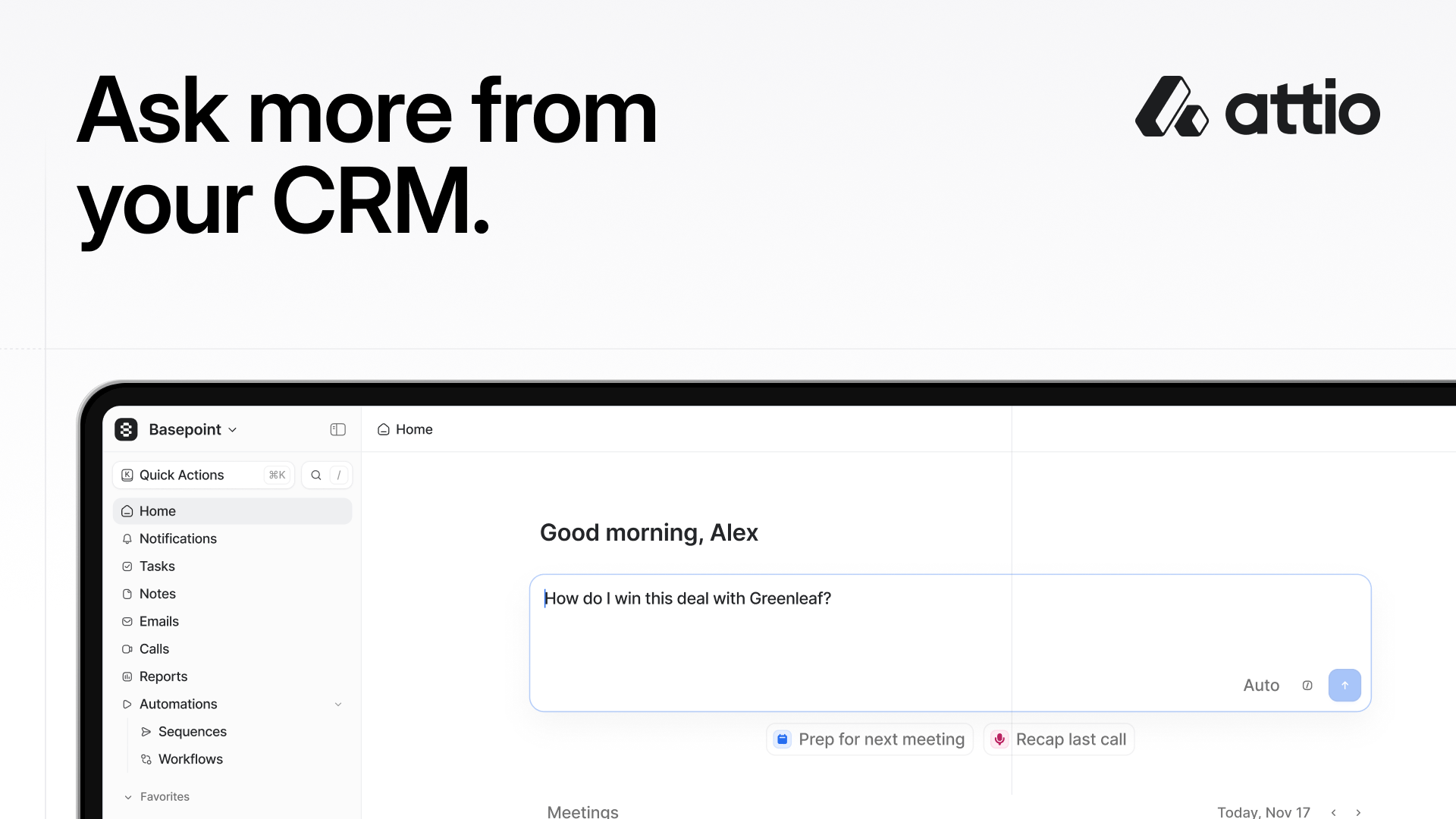
Connect your email, calls, product data and more, and Attio instantly builds your CRM with enriched data and complete context. Whether you’re running product-led growth or enterprise sales, Attio adapts to your unique GTM motion.
Then Ask Attio to plan your next move.
Run deep web research on prospects. Update your pipeline as you work. Find customers and draft outreach emails. Powered by Universal Context, Attio's intelligence layer, Attio searches, updates, and creates across your data to accelerate your workflow.
Ask more from your CRM.
ON THE HORIZON 🌅
Claude Corps: Anthropic’s $150M Bet on an AI-Skilled Workforce

Anthropic is launching Claude Corps, a national fellowship that will train 1,000 early-career workers and place them full-time inside nonprofits across the United States. Fellows will spend 12 months helping their host organizations introduce Claude, automate work, build internal systems, and expand their impact. Anthropic is committing an initial $150 million to the program.
Fellows will receive an $85,000 salary and benefits, intensive training, ongoing mentorship, technical office hours, and a large Claude usage allowance. At least 400 nonprofits will participate during the first year, spanning education, food assistance, veteran support, environmental conservation, workforce development, and community services. The first group of 100 fellows begins in October 2026, with additional cohorts scheduled for January and August 2027.
The larger experiment is whether a structured public-service fellowship can distribute AI skills while giving workers practical experience during a period of economic disruption. Anthropic plans to measure both nonprofit outcomes and fellow career development, open-source parts of the underlying program infrastructure, and potentially expand the model beyond the United States. If it succeeds, Claude Corps could become a blueprint for national-scale AI workforce programs.
LATEST IMPORTANT NEWS 📰
A New Computing Architecture Takes Aim at AI’s Power Problem
Unconventional AI, founded by former Databricks AI chief Naveen Rao, introduced Un-0, an image-generation model built around a simulated oscillator-based computing architecture. The company says the approach could eventually perform inference using as little as one-thousandth of the power required by conventional systems. Un-0 currently runs in software rather than on custom hardware, so the headline energy claim remains a target rather than a demonstrated chip-level result. The company plans to release chip schematics and ultimately operate its own inference infrastructure. It is a massive technical gamble, but energy availability is rapidly becoming one of the hardest constraints on AI growth.
Can Video Games Teach Robots How the World Works?
General Intuition raised $320 million at a $2.3 billion valuation to train general-purpose agents using hundreds of millions of hours of video game footage from Medal. Its advantage is the action data attached to those clips, including which buttons players pressed and when, giving the model information about both observations and causes. The company says the same underlying system can control a game agent, operate inside generated environments, and power physical robots; one quadruped demonstration reportedly required only eight minutes of real-world fine-tuning data. The open question is whether those capabilities will transfer reliably to varied physical environments at scale, but investors are betting that gameplay could provide a far cheaper training ground than collecting comparable robotics data in the real world.
Patronus Builds Digital Test Tracks for AI Agents
Patronus AI raised a $50 million Series B to create simulated replicas of websites, software tools, and internal business systems where AI agents can be evaluated without touching live infrastructure. These “digital worlds” allow developers to test whether agents complete complex tasks correctly, take shortcuts, or fail under unusual conditions. Patronus is starting with software engineering and finance and wants to support evaluations that run continuously for hours, days, or even weeks. As agents gain more authority, realistic stress testing could become as important as the models themselves, particularly in workflows where a plausible-looking mistake can carry real financial or operational consequences.
One AI employee. Engineering, finance, growth, ops.

Last week Viktor opened 14 pull requests, closed two month-end books, drafted a board update, deployed three landing pages, and triaged 600 support tickets. From inside Slack and Microsoft Teams. 20,000+ teams now run this way.
FOR THE TECHNICALLY INCLINED 🛠️
Qwen-AgentWorld Simulates the Environments Around an Agent
Qwen has released Qwen-AgentWorld, a 35-billion-parameter open-weight model trained to predict how digital environments respond to an agent’s actions. It supports seven domains, including search, terminals, software engineering, web browsing, operating systems, Android, and the Model Context Protocol. Instead of repeatedly launching real browsers, devices, or terminals, developers can use the model as a configurable simulator for agent training and evaluation.
Qwen reports that reinforcement learning inside the simulated environment outperformed training in the live environment on a search task, reaching 50.3% versus 45.6% F1, and that the model led AgentWorldBench against systems including GPT-5.4 and Claude Opus 4.8. The model is available under Apache 2.0 and can be served with vLLM or SGLang. If these results generalize, environment models could make agent experimentation faster, cheaper, and easier to reproduce.
AI TOOL OF THE DAY 🚀
Monoshoot turns ordinary product photos into studio-grade visuals for ecommerce, advertising, and social media while keeping the product itself accurate and unchanged.
10x the context. Half the time.

Speak your prompts into ChatGPT or Claude and get detailed, paste-ready input that actually gives you useful output. Wispr Flow captures what you'd cut when typing. Free on Mac, Windows, and iPhone.
That's all for now!
We'll catch you in the next one.
Cheers,
The AI Horizons Team
P.S. If you missed our last issue, no worries, you can check out all previous issues here!
P.P.S We value your thoughts, feedback, and questions - feel free to respond directly to this email!
... and if you enjoyed this email and would like to support our work and help us keep bringing you cutting-edge AI insights, you can donate here. Every bit makes a difference—thank you for your support!
What did you think about today's email? |