- AI Horizons
- Posts
- Perplexity’s “Personal Computer,” AI Agents Take Over WordPress, and Bots May Outnumber Humans Online
Perplexity’s “Personal Computer,” AI Agents Take Over WordPress, and Bots May Outnumber Humans Online
PLUS: A $1B bet on world-model AI, Google’s full-stack app generator, and DoorDash turns gig workers into AI trainers
In partnership with

Welcome back to AI Horizons, your weekly guide to the latest in AI and tech for builders, leaders, and curious minds everywhere. Here’s what’s on deck:
Perplexity Personal Computer
AMI $1B world models
WordPress AI publishing
AI bot traffic surge
DoorDash AI data tasks
Google AI app builder
FEATURED INSIGHT💡
Perplexity Wants AI to Become Your Operating Layer

Perplexity just laid out a much bigger vision than “AI search.” With its new Personal Computer, the company is pitching an always-on AI system running through a dedicated Mac mini that can work across your files, apps, and sessions around the clock. The idea is simple but ambitious: instead of opening tools yourself and moving work between them manually, you hand off goals to an AI system that keeps going after you step away.
What makes this notable is the shift from assistant to proxy. Perplexity is not just talking about answering questions faster. It is positioning Computer as a system that can reason across tools, access context, take actions in secure environments, and keep workflows running continuously. That same logic now extends beyond individuals into enterprise workflows, browser control through Comet Enterprise, developer APIs, premium research sources, and finance tooling with traceable live data from sources like SEC filings and FactSet.
The bigger takeaway is that AI platforms are starting to converge around a new model of computing: persistent, tool-using systems that sit above traditional software and coordinate it for you. If this category matures, the most important interface may no longer be the app itself. It may be the agent that knows your intent, has access to your environment, and can move between systems on your behalf with audit trails, permission layers, and kill switches built in.
“AI is Going to Fundamentally Change…Everything”

That’s what NVIDIA CEO Jensen Huang just said about the AI boom, even calling it “the largest infrastructure buildout in human history.”
NVIDIA’s chips made this real-time revolution possible, but now it’s collaborating with Miso to unlock amazing new advances in robotics
Already a first-mover in the $1T fast-food industry, Miso’s AI-powered Flippy Fry Station robots have worked 200K+ hours for leading brands like White Castle, just surpassing 5M+ baskets of fried food.
And this latest NVIDIA collaboration unlocks up to 35% faster performance for Miso’s robots, which can cook perfect fried foods 24/7. In an industry experiencing 144% labor turnover, where speed is key, those gains can be game-changing.
There are 100K+ US fast-food locations in desperate need, a $4B/year revenue opportunity for Miso. And you can become an early-stage Miso shareholder today. Hurry to unlock up to 7% bonus stock.
This is a paid advertisement for Miso Robotics’ Regulation A offering. Please read the offering circular at invest.misorobotics.com.
ON THE HORIZON 🌅
AMI Is Betting the Next Breakthrough in AI Starts With the Real World

A new company called Advanced Machine Intelligence (AMI) is making a very large and very specific bet: that the future of AI will not be built by scaling language systems alone. The company says it is building AI that understands the real world, retains persistent memory, can reason and plan, and remains controllable and safe. To push that vision forward, it has raised a $1.03 billion round and launched as a frontier lab with teams across Paris, New York, Montreal, and Singapore.
What stands out here is the technical framing. AMI is focused on world models that learn abstract representations from noisy, high-dimensional sensor data and make predictions in representation space instead of trying to generate every raw detail. In practical terms, that points toward AI systems that are better suited for robotics, wearables, industrial automation, and healthcare, where reliability and action matter more than clever text generation. If more labs move in this direction, we may look back on the current AI wave as a language-first phase before a broader shift into systems that model the physical world more directly.
LATEST IMPORTANT NEWS 📰
WordPress.com now lets AI agents write and publish posts
This is a meaningful shift because WordPress is one of the web’s foundational publishing layers, and giving AI agents the ability to draft posts, edit metadata, organize categories, manage comments, and make structural updates could accelerate the rise of semi-autonomous websites. The company says changes remain approval-based and AI-written posts default to drafts, but the broader implication is clear: more of the web may soon be maintained by machines, not humans.
Cloudflare’s CEO says bot traffic could exceed human traffic by 2027
That prediction captures a bigger platform shift already underway, where AI agents do not browse like people. They fan out across thousands of pages to complete a single task, which creates real infrastructure strain and forces companies to rethink caching, security, availability, and agent-specific compute environments. If that forecast is even directionally right, the web’s next chapter will be shaped as much by machine-to-machine activity as by human audiences.
DoorDash launched a new Tasks app that pays couriers to help generate AI training data
The interesting part here is not just the app itself, but the labor model behind it. DoorDash is turning its distributed workforce into a data-collection layer for AI and robotics by paying workers to record physical actions, environments, and speech. That suggests a broader trend where companies with large real-world networks may have an advantage in training systems that need grounded, physical-world data instead of more text scraped from the internet.
Your next great hire lives in Slack.
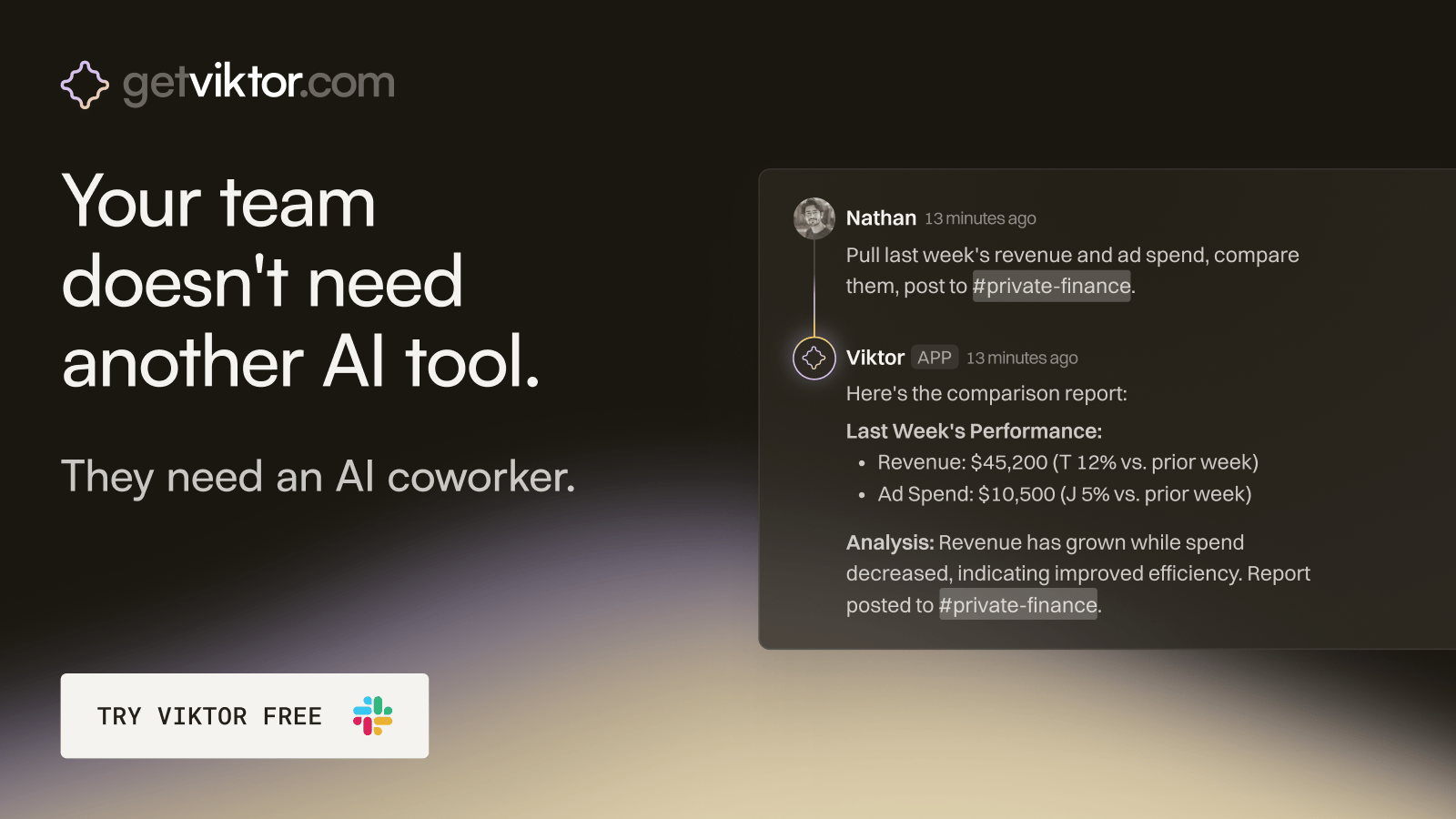
Viktor is an AI coworker that connects to your tools and ships real work. Ask Viktor to pull a report, build a client dashboard, or source 200 leads matching your ICP. Most teams hand over half their ops within a week.
FOR THE TECHNICALLY INCLINED 🛠️
Google AI Studio Is Pushing “Vibe Coding” Closer to Real Software
Google’s upgraded AI Studio is moving beyond toy demos and leaning into full-stack generation. With the new Antigravity agent and built-in Firebase integrations, users can prompt their way into working apps that include frontend, backend, authentication, database support, real-time features, and external service integrations. The most important technical shift is not just code generation, but the persistent agent layer that keeps track of project structure and session history so work can continue with less repetition and better context.
For developers, that means the center of gravity is moving from isolated code completions toward longer-running agents that can manage architecture, dependencies, secrets, frameworks, and multi-step edits in one environment. It is another sign that AI coding tools are becoming more orchestration-heavy, not just autocomplete with better branding.
AI TOOL OF THE DAY 🚀
AIReel helps turn an image or short text prompt into social-ready videos and images using built-in templates geared toward faster reel and short-form content creation.
Attio is the AI CRM for modern teams.

Connect your email and calendar and Attio instantly builds your CRM. Every contact, every company, every conversation — organized in one place. Then ask it anything. No more digging, no more data entry. Just answers.
That's all for now!
We'll catch you in the next one.
Cheers,
The AI Horizons Team
P.S. If you missed our last issue, no worries, you can check out all previous issues here!
P.P.S We value your thoughts, feedback, and questions - feel free to respond directly to this email!
... and if you enjoyed this email and would like to support our work and help us keep bringing you cutting-edge AI insights, you can donate here. Every bit makes a difference—thank you for your support!
What did you think about today's email? |